This is the report that I wrote in the context of the ASPERA-2 EU FP7 project. I am soooo proud of it!
Friday, 6 April 2012

Academic Dishonesty: Students’ Corruption
[this is not very related to science but it is an issue I feel very strongly about. This was my essay for the Ethics and Corruption in the public sector course I took during my Masters in Public Policy.]

1. DESCRIPTION
One of the behaviours that negatively
affect an educational system is the very high levels of students’
academic dishonesty. This is especially the case for written examinations, the
main assessment procedure in both high-school and university level education in
Greece.
Academic dishonesty is a very dangerous
type of corruption because it happens when people are at such a young age, at
the stage when they learn how to think, try to find out what they believe in
and develop into the people that they will eventually become. If a behaviour is
perceived as correct or normal at this stage, it is more likely that it will be
repeated for the rest of the life of the individual, or even be transferred in
situations outside education. By adopting such a corrupt behaviour at such an
early stage, young people are more likely to be corrupt as adults as
well.
Academic dishonesty in the context of
written examinations exists in many forms. Students can increase their chances
of getting good grades by finding out the questions before the exam, copying
from other students during the exam, copying from material brought into the
exam room (notes in the bag, on the floor, in pencil cases, etc), from texts written
on their hands, arms, thighs etc, and/or using technology (e.g. using mobile
phones to obtain answers from the internet or from friends at home) or even by sending
someone else to sit the exam for them. All these forms of cheating are used to
great extents depending on the situation.
The focus of this essay will be university
students who are performing any of the above behaviours during their higher
education studies. They are the ones who initiate and benefit from the
corrupted act of cheating in written examinations. The alarming trend that served as inspiration
for this essay is the increasing number of university students that consider cheating
as an integral and justified part of their studies, even a right. The majority
of students nowadays consider it completely independent of corruption.
Thursday, 13 October 2011
Development of the National Strategic Framework Programme for RTDI (ESPEK): 2014 - 2018
Monday, 11 July 2011
WebWise: Web 2.0. supported Higher Education Institutional Learning Scenarios for Collaborative Learning
WEBWISE is a European Project with subject Web 2.0. supported Higher Education Institutional Learning Scenarios for Collaborative Learning
http://www.flickr.com/photos/webwise_project/
Health and education are amongst the most important social and economic resources in contemporary Europe as in the rest of the world, and both are facing very substantial transformation process. Accordingly, the current healthcare education system is coping with a wide-spectrum of challenges, the most notable of which being the inclusion of the ever increasing skill and training requirements for healthcare graduates as well as innovation in many fields.
What is more, the Bologna Process has brought about a series of important reforms in Higher Education, having initiated processes aiming significant harmonization in recognition, course structure and quality assurance to name but a few examples. An even cursory look at the instruments created by Bologna process shows an emphasis on flexible learning pathways, recognition of prior learning, widening access to second cycle studies and a host of other instruments aimed at doing quite the opposite of the negative perceptions of the process.
With this in mind, WebWise brings together a range of European higher education institutions active in the field of public health education as well as experts for innovating e-learning, to analyze, experiment and develop innovative learning scenarios within public health education.
The general objective of WebWise is to support the improvement, the quality, the efficiency and the accessibility of Higher Education using the structure of the Bologna process and the innovative methodological collaborative Web 2.0. learning tools. Within this objective, the project will aim to:
Its target groups are:
in public health and public health related study programmes.
Please visit its webpage: http://projekte.hs-magdeburg.de/whole/course/view.php?id=97
http://www.flickr.com/photos/webwise_project/
Health and education are amongst the most important social and economic resources in contemporary Europe as in the rest of the world, and both are facing very substantial transformation process. Accordingly, the current healthcare education system is coping with a wide-spectrum of challenges, the most notable of which being the inclusion of the ever increasing skill and training requirements for healthcare graduates as well as innovation in many fields.
What is more, the Bologna Process has brought about a series of important reforms in Higher Education, having initiated processes aiming significant harmonization in recognition, course structure and quality assurance to name but a few examples. An even cursory look at the instruments created by Bologna process shows an emphasis on flexible learning pathways, recognition of prior learning, widening access to second cycle studies and a host of other instruments aimed at doing quite the opposite of the negative perceptions of the process.
With this in mind, WebWise brings together a range of European higher education institutions active in the field of public health education as well as experts for innovating e-learning, to analyze, experiment and develop innovative learning scenarios within public health education.
The general objective of WebWise is to support the improvement, the quality, the efficiency and the accessibility of Higher Education using the structure of the Bologna process and the innovative methodological collaborative Web 2.0. learning tools. Within this objective, the project will aim to:
- Identify innovative learning scenarios and learning designs within public health or general health education
- Suggest and test a number of innovations to improve the learning process within the scenarios
- Identify and elaborate the key improvements from the pilots
- Recommend how such improvements may be transferred in public health education and to other areas of Higher Education
- Disseminate recommendations to competent authorities on a national and European level
Its target groups are:
- Regulatory bodies
- Managers
- Deliverers
- Users
in public health and public health related study programmes.
Please visit its webpage: http://projekte.hs-magdeburg.de/whole/course/view.php?id=97
Wednesday, 1 June 2011
Thursday, 5 May 2011
Young Europeans Discuss Sustainable Development
I have been absent from this blog because I have been organising the Young Europeans Discuss Sustainable Development from the point of view of science and technology event:

Young Europeans Discuss Sustainable Development
9-14 of May 2011
9-14 of May 2011
Advances in Science and Technology
28 Young Europeans (18-24 years old) from 13 EU countries, will be discussing with Greek scientists about6
Meet the 23 scientists that will talk at the event! They work at almost all of the big Greek universities and research centres!
Learn about the issues that will be discussed:
Climate Change, Energy, Innovation, Water and Food, Biodiversity, Public Health
Chat with other people!
Check out what will be happening during that week!
Find out about the participants!
Watch online, ask questions for the scientists to answer, vote!
The event language is English.
Please forward this to your members and whoever you think might be interested.
For more information do not hesitate to contact us at yedsda@gmail.com
Dr Ino Agrafioti
Saturday, 12 February 2011
The first women astronomers
I have never been one of these scientists that see themselves as women scientists rather than scientists. Similarly, I am not usually looking at women scientists' lives because they are women, but because they are scientists. Some would disagree with me on that point, but this is an issue for a whole different post.
Nevertheless, these women, the first modern day women astronomers, caught my interest while reading a popular physics book. Maybe this was because up to that point I kept reading only about men, so when I read about a woman, I paid extra attention. I know this is not directly related to the theme of this blog, but I thought I should write something, just in case you do not know about them.
You can see what Pickering looked like in this later photograph - I have included the caption from the source since it shows that these women were educated (https://www.cfa.harvard.edu/~jshaw/pick.html):Nevertheless, these women, the first modern day women astronomers, caught my interest while reading a popular physics book. Maybe this was because up to that point I kept reading only about men, so when I read about a woman, I paid extra attention. I know this is not directly related to the theme of this blog, but I thought I should write something, just in case you do not know about them.
Women entered astronomy - a mostly forbidden field up to then - thanks toone man and one woman. The man was Edward Charles Pickering who became director of the Harvard College Observatory in 1877. The woman was Anna Mary Palmer, the wife of Henry Draper whose intention was to photograph the entire night sky. Henry Draper did not manage to do so before he died, so his wife donated money to the Harvard College Observatory after his death.
Edward C Pickering decided that women would be better to complete this monumental task, so he hired his "Harem" or his "Computers". Yes, you read right. These women were called "computers". I find this awful for some reason. Others might find the 'Harem' term worse. At least the term harem shows they are women, whereas computers are neutral. Anyway, Pickering hired approximately eighty women during his directorship at Harvard College Observatory, which was amazing for that time (link). Saying that, they earned 25 cents per day, which was less than what the secretaries at the university earned, so by hiring them he also saved money. These women were responsible of catalogueing, indexing, examining and caring for the new photographic plates, identifying the stars on them and then calculating their positions.
Edward C Pickering decided that women would be better to complete this monumental task, so he hired his "Harem" or his "Computers". Yes, you read right. These women were called "computers". I find this awful for some reason. Others might find the 'Harem' term worse. At least the term harem shows they are women, whereas computers are neutral. Anyway, Pickering hired approximately eighty women during his directorship at Harvard College Observatory, which was amazing for that time (link). Saying that, they earned 25 cents per day, which was less than what the secretaries at the university earned, so by hiring them he also saved money. These women were responsible of catalogueing, indexing, examining and caring for the new photographic plates, identifying the stars on them and then calculating their positions.
 |
| "Pickering's Harem". The group included Harvard computer and astronomer Henrietta Swan Leavitt (1868–1921), Annie Jump Cannon (1863–1941), Williamina Fleming (1857–1911), and Antonia Maury (1866–1952). Photograph courtesy of the Grasslands Observatory. Date: circa 1900–1910. Original Source: http://www.3towers.com/sgrasslands/essays/Leavitt/Leavitt03.asp |
 |
| This picture was taken on 13 May 1913 in front of Building C, which faces north. It was specially built of brick to protect the astronomical data and glass negatives from fire. Since the astronomical photographs were stored on the ground floor and most of the women worked on the top floor, the building had a dumb waiter to convey the plates up and down. The women all worked in a large room on the east end of the third floor. Pickering had his offices on the west end across the central hallway. All the other men worked on the lower levels. At the far left of the photograph is Margaret Harwood (AB Radcliffe 1907, MA University of California 1916), who had just completed her first year as Astronomical Fellow at the Maria Mitchell Observatory. She was later appointed director there, the first woman to be appointed director of an independent observatory. Beside her in the back row is Mollie O'Reilly, a computer from 1906 to 1918. Next to Pickering is Edith Gill, a computer since 1889. Then comes Annie Jump Cannon (BA Wellesley 1884), who at that time was about halfway through classifying stellar spectra for the Henry Draper Catalogue. Behind Miss Cannon is Evelyn Leland, a computer from 1889 to 1925. Next is Florence Cushman, a computer since 1888. Behind Miss Cushman is Marion Whyte, who worked for Miss Cannon as a recorder from 1911 to 1913. At the far right of this row is Grace Brooks, a computer from 1906 to 1920. Ahead of Miss Harwood in the front row is Arville Walker (AB Radcliffe 1906), who served as assistant from 1906 until 1922. From 1922 until 1957 she held the position of secretary to Harlow Shapley, who succeeded Pickering as Director. The next woman may be Johanna Mackie, an assistant from 1903 to 1920. She received a gold medal from the American Association of Variable Star Observers (AAVSO) for discovering the first nova in the constellation of Lyra. In front of Pickering is Alta Carpenter, a computer from 1906 to 1920. Next is Mabel Gill, a computer since 1892. And finally, Ida Woods (BA Wellesley 1893), who joined the corps of women computers just after graduation. In 1920 she received the first AAVSO nova medal; by 1927, she had seven bars on it for her discoveries of novae on photographs of the Milky Way. |
Of these women, four have really stood out. You can find more details in Wikipedia, so I will just write a few words for each, the points which I found most interesting (the quotes are from https://www.cfa.harvard.edu/~jshaw/pick.html):
1. Williamina Paton Stevens Fleming (1857-1911)
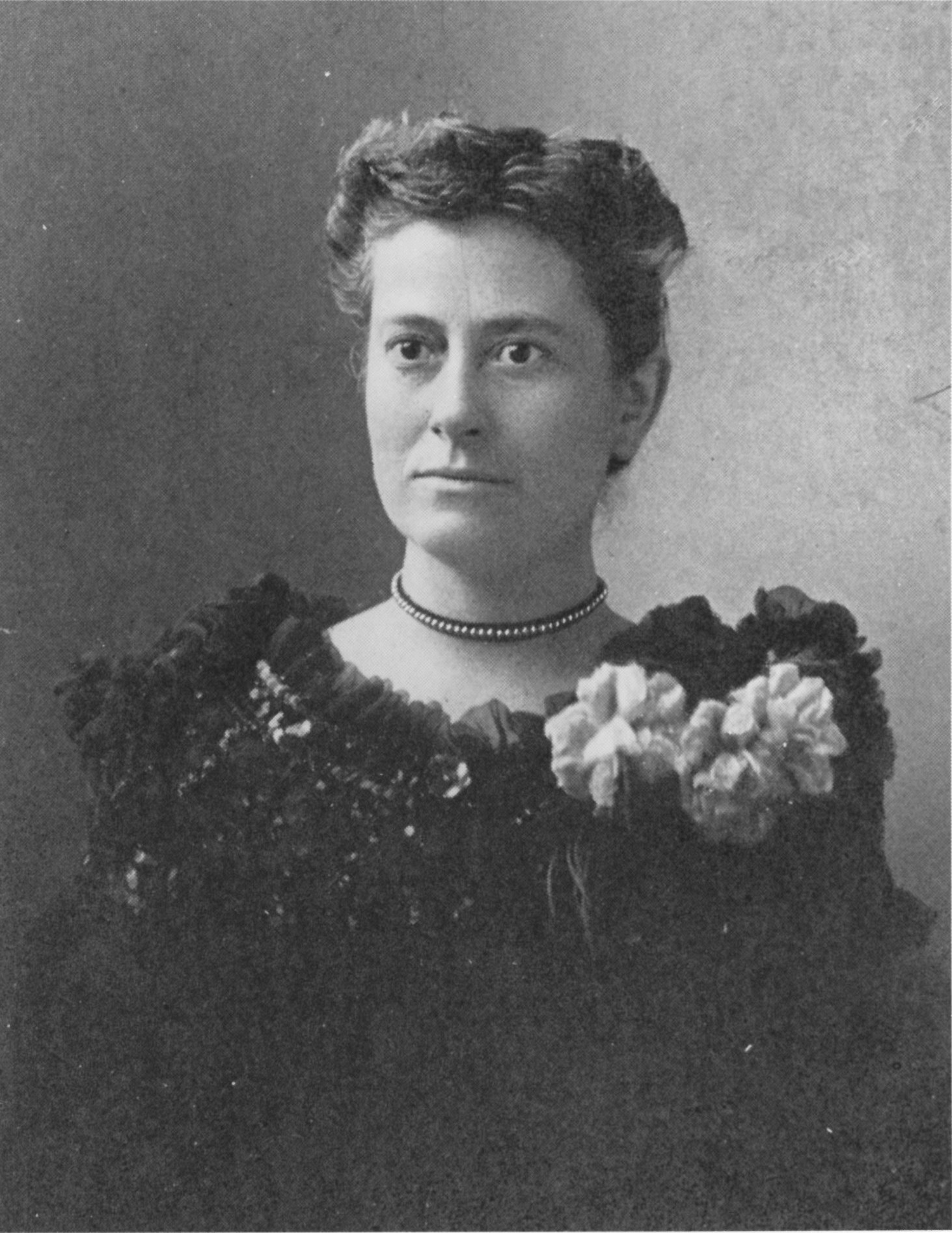
Born Scottish, she moved to the US with her husband who then abandoned her and her unborn child, so she became the Housekeeper of E. Pickering, who then hired her as one of his team. In nine years, she catalogued more than 10,000 stars, discovered 59 gaseous nebulae (including the Horsehead), over 310 variable stars, and 10 novae.
Fleming was placed in charge of dozens of women hired to do mathematical classifications and edited the observatory's publications. She devised her classification system which divided the stars into classes based on “the complexity of the spectrum lines and bands and the strength of the spectral lines due to hydrogen”.
In 1890, the first Henry Draper Catalogue was published in the Annals of the Harvard College Observatory. It contained most of the stars visible to the unaided eye, a total of 10,351 stars. Though Fleming was not listed as an author, Pickering did acknowledge her contribution to the work. She was also widely recognized by the astronomical community.In 1899, Fleming was given the title of Curator of Astronomical Photographs and in 1906, she was made an honorary member of the Royal Astronomical Society of London, the first American woman to be so selected.
Antonia Maury (1866–1952)
While at Harvard College Observatory, Draper's wive's nice, Antonia Maury, observed stellar spectra and published a catalogue of classifications in 1897. During Maury’s cataloguing work, she rearranged Fleming’s scheme to reflect the temperatures of stars. She further refined the sequence by adding another “dimension” to describe the spectral lines. Pickering, disagreed with Maury’s system of classification and explanation of differing line widths, so she left. However, Ejnar Hertzsprung realized the value of her classifications and used them in his system of identifying giant and dwarf stars.
In 1908, Antonia Maury returned to Harvard where she remained for many years. Her most famous work there was the spectroscopic analysis of the binary star Beta Lyrae, published in 1933. In 1943, Antonia Maury was awarded the Annie Jump Cannon Award in Astronomy by the American Astronomical Society.
Annie Jump Cannon (1863–1941)
Since 1896 Cannon’s duties included cataloguing variable stars and classifying the spectra of stars in the southern hemisphere for the Henry Draper Catalogue project, the counterpart to Maury with the northern hemisphere. Cannon took over the duties as Curator of Astronomical Photographs when Fleming died in 1911.
Possibly due to her deafness, Cannon was “recognized even during her lifetime as the world’s expert in identifying and classifying stars, with incredible accuracy and speed.” By the time of her death, she had classified up to 350,000 stars, at a rate of up to 300 per hour.
Annie Jump Cannon also negotiated a compromise between the two systems of Fleming and Maury and put an end of the disagreement. According to her system stars are divided into the spectral classes O, B, A, F, G, K, M. The mnemonic of "Oh Be a Fine Girl and Kiss Me" was developed as a way to remember it. Her category scheme was so “user-friendly,” it was officially adopted as the standard in 1910 by the International Astronomical Union. Today, with minor changes, Cannon’s system is known as the Harvard Spectral Classification.
Cannon was recognized by her peers for her contributions to astronomy. She received six honorary degrees, one from Oxford University, the first given to a woman, and was the first woman to receive the Draper Gold Medal. With the money she received from one award, the Ellen Richards Research Prize of the Association to Aid Scientific Research by Women, Cannon established an award to recognize contributions to astronomy by women.

Henrietta Swan Leavitt (1868–1921)
Leavitt was the woman I read about in my book, she was the one who lead me to all this. Like Cannon, Leavitt became deaf during her traveling. I find this really interesting! :):)
In 1902, Pickering hired her on the permanent staff at $.30 per hour. As an assistant at Harvard, she was given little theoretical work since Pickering did not like his female staff to pursue such endeavors. Instead, she was given the position of chief of the photographic photometry department and was responsible for the care of telescopes. But she also worked with the rest of the team on the plates. Her task was to determine the magnitudes of stars. Her system was recognized by the scientific community as an important standard and in 1913, was adopted by the International Committee on Photographic Magnitudes.
But what she is most known for, was her work that lead to Hubble's discovery that the universe is expanding. By studying Cepheid variables in the Small Magellanic Cloud she determined the absolute magnitudes of stars. Her study led to the period-luminosity relationship.

How amazing could these women have been!!!!
Saturday, 15 January 2011
Subscribe to:
Posts (Atom)