Wednesday, 14 July 2010
Research and more in crisis
On the 8th of July, my article on Research policy in Greece was published in ResearchEurope.

Saturday, 10 July 2010
Why am I surprised?
One could say that in this blog, I focus too much on UK science policy news, or generally UK science-related events, trends etc. I have to admit, I find them a tiny bit easier to understand, given that I did all my studying in the UK.
But there is another reason why I focus on the UK. I am still a bit scared to look at what is happening in Greece. Probably, since 2002, when as a naive 2nd year undergraduate, right in the middle of my tree-hugging phase, I looked online to find out what my government's views were on GM. I was against GM back then, so I was happy to read that the Greek government was too. However, the reality was very different. Since the government did very little to control GM crops, there were many GM fields in Greece. If I remember correctly, they had to burn huge areas when they found out about them, in order to show they were truly against GM. I was very disappointed to say the least.
My problem with science policy issues - e.g. libel law, abortion, animal rights, MMR, homeopathy, etc - is that I have huge gaps in my knowledge since I only recently started to be interested in them. I have no idea what are the facts, what are the arguments for and against, for many of these issues. Immersed in my world of theoretical genomics, I did not really pay attention when I was in the UK. This was a good thing in a way, because I managed to get my PhD very young, but on the other hand, I now feel completely overwhelmed. Don't worry, you might say, there is plenty of time. You are right.
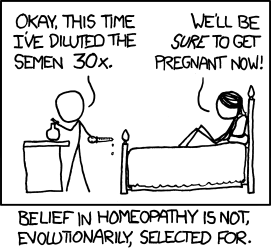
Homeopathy is one of the issues I know nothing about in terms of policy. I have met people of course that use it regularly, but i have no idea what is going on exactly with doctor certification, government expenditure, etc.
I have to admit that when I was 13 I went to a homeopathic practitioner. Well, I did not have an appointment as such: I was on holiday with my parents, when a common friend told me to go visit him at his holiday home. The reason she sent me was that when she gave me a massage, she found that apparently "I had too much garbage in me". I did not do the therapy he suggested for long - it was ridiculous! - and the whole story was forgotten. I still remember how traumatising the "garbage" thing was. But then again a lot of doctors have told me a lot of traumatising things, so that is a different story.
I only recently found out about the efforts of Dr Evan Harris and many many others, to make sure that there is proof that all homeopathic drugs provided by the NHS improve people's health better than a placebo. This is an idea that makes COMPLETE sense to me and I am finding it very hard to understand why would someone not agree with such a statement. Also, I only recently found out that homeopathic medicines are so diluted that the chances that you actually get what it says on the label are almost zero.
This is how far my knowledge stretches on the issue in the UK, and I have not had the time to find out what the situation is like in Greece.
Until yesterday.
It all started when my boss told me in the middle of a completely unrelated conversation "Don't you know about George Vithoulkas?". Of course I hadn't. "He got the Alternative Nobel Prize, look him up!", he continued. My boss is a bit like President Bartlett in the West Wing: he makes me look up completely unrelated things just for the shake of it (I have to say, I do not mind when he does this, given how poor my general knowledge is). So... I looked him up.
George Vithoulkas:
studied homeopathy in South Africa and received a diploma in homeopathy from the Indian Institute of Homeopathy in 1966. Upon receiving his diploma, he returned to Greece where he practiced and began teaching classical homeopathy to medical doctors at what eventually became the Center of Homeopathic Medicine in Athens. In 1972, Vithoulkas started a Greek homeopathic journal, Homeopathic Medicine. In 1976, he organized the first of an annual series of International Homeopathic Seminars. In 1994, he opened the International Academy of Classical Homeopathy on Alonissos, which provides post-graduate training for homeopaths
Vithoulkas has authored a number of books on homeopathy, two of which "Homeopathy: Medicine of the New Man" and "The Science of Homeopathy" have been translated extensively, and is currently writing Materia Medica Viva, a homeopathic materia medica or reference work on homeopathic remedies, to reach 16 volumes when finished.All this won him in 1996 the Right Livelihood Award - known as the Alternative Nobel Prize - for his outstanding contribution to Classical Homeopathy.
Maybe he knows how outrageous it is that a postgraduate course for homeopaths exists officially at a Greek University, since he seems almost surprised when he boasts about it on his website:
But the climax of homeopathy’s educational recognition in Greece is the publication in the FEK (Government’s Gazette) (1912/issue b’, 29.12.2006) regarding the authorization for a Program of Master Degree Studies in the University of the Aegean for medical doctors and dentists with the title “Holistic Alternative Therapeutic Systems–Classical Homeopathy” (duration: 2 years- www.syros.aegean.gr/homeopathy). In this Program of Master Degree Studies will participate the International Academy of Classical Homeopathy and Professor George Vithoulkas.What is the name of department that this course belongs to? The Department of "Product and Systems Design Engineering". This department which also provides one graduate studies program (5-year B.Eng. degree: Product and Systems Design Engineering) and another MSc studies program (Design of Interactive and Industrial Products and Systems).
In what parallel universe does a homeopathy course fit in a university that is mainly focused on engineering? How did the government give its consent for such a course??
My boss told me that it is the only postgraduate course in Europe on Homeopathy. I briefly looked it up and discovered that it is definitely not the only one: there is the Homeopathy by e-learning at School of Nursing & Caring Sciences, University of Central Lancashire.
Then I read at the website of the European Committee for Homeopathy
Postgraduate training courses in homeopathy for doctors are provided at universities in Bulgaria, France, Italy, Lithuania and Spain, in other countries at private teaching centres.And I quote only the part on postgraduate courses. There is more on where this came from.
Homeopathy is an official part of the Continuous Education Programme for doctors in Hungary and Romania.
A lectureship specifically for homeopathy exists only in the Netherlands (Amsterdam), a professorial chair of CAM including homeopathy in Hungary (Pécs) and Switzerland (Bern).
So... On the positive side, Greece is not the only country that provides approved university MSc courses on homeopathy. On the negative side, one of the internationally most recognized supporters of Homeopathy is Greek.
Given that the positive side is not that positive and the negative side is very negative, this is of course a very disappointing reality.
But... why am I surprised?
Friday, 2 July 2010
Science and Society: step 2 is to plot the data...
This is just a teaser of the data i am plotting. This is maybe the question that has the biggest difference between Greece and the UK, but I am half way through all the eurobarometer tables.

So a lot more Greek people feel that "because of their knowledge, scientists have a power that makes them dangerous". When all EU27 countries are ranked according to their belief in this statement, Greece is on the one end of the spectrum (2nd most agreeing) and the UK is at the other end of the spectrum (6th least agreeing).
Could this maybe be part of the explanation to my question, for the difference between the two countries?

So a lot more Greek people feel that "because of their knowledge, scientists have a power that makes them dangerous". When all EU27 countries are ranked according to their belief in this statement, Greece is on the one end of the spectrum (2nd most agreeing) and the UK is at the other end of the spectrum (6th least agreeing).
Could this maybe be part of the explanation to my question, for the difference between the two countries?
Monday, 28 June 2010
Science and Society: step 1 is to set the question...
Why is there reaction to science-related issues in some countries, and in others not so much?
Having lived for almost a decade in a country where there were big reactions to science issues (MMR, mad cow, etc), and having moved back to a country where the reactions are not so big - one could say non-existent - it makes me wonder why is this the case?
Of course it comes down to society, but why? What I mean is, of course there are big differences between the British and Greek societies, but which of these differences cause reaction in the former and not in the latter?
This question has been brewing in my mind for quite sometime now since it is different to communicate science to a society that is against it, than to a society that simply does not care. (A related question: why it does not care?)
Ι decided to set the task of answering the question above when I read the rapid response of some people in - once again - the UK.
In a recent comment, Guardian columnist Simon Jenkins (you can find the article here), basically said that scientists, with Martin Rees and Lord May as their archbishops, "just want money" "based on faith, not reason". Jennifer Rohn, two days later published a post in her blog were she "proposed making Monday," today that is, "Spoof Jenks day, with bloggers taking the opportunity to writing an anti-science post in the style of Simon Jenkins". The idea was well received and in just 2 days there were not 1, not 2, not 5 but 11 Spoof Jenkins posts (you can find them at the end of this post but for a more updated list please check at the original post by Jennifer Rohn). Please also use the "#SpoofJenks" hashtag on twitter.
So this is a science-related issue and there was a fast reaction from the scientists. (I am so damn impressed when the reaction is so great!). In other cases, it is the creationists that react fast. I does not matter who does. Here I am talking about the reaction itself.
It makes me wonder, why is it that in the UK, in France, in the US, in Germany, etc there are reactions whereas in other countries there are not that many? Is it just my unfamiliarity with Greek reality or is this truly the case?
So, for the next couple of months this is what I will be thinking about... any help, ideas, will be much appreciated!
PS. The SpoofJenks posts
1. Get over it, scientists: your cushy days are numbered
2. Urgent new priority for UK science
3. A Mammoth of Research
4.Jenks from tectum to rectum
5. Perpetual Poetry in Motion
6. Not a guest post and not by Simon Jenkins
7. Simon Jenkins collects his tithe
8. A day in the life of Simon Jenkins
9. We know too much
10. Cancer: Scaremongering 'Scientists' Ramp Up The Fear
11. Bloody scientists think they know everything
Having lived for almost a decade in a country where there were big reactions to science issues (MMR, mad cow, etc), and having moved back to a country where the reactions are not so big - one could say non-existent - it makes me wonder why is this the case?
Of course it comes down to society, but why? What I mean is, of course there are big differences between the British and Greek societies, but which of these differences cause reaction in the former and not in the latter?
This question has been brewing in my mind for quite sometime now since it is different to communicate science to a society that is against it, than to a society that simply does not care. (A related question: why it does not care?)
Ι decided to set the task of answering the question above when I read the rapid response of some people in - once again - the UK.
In a recent comment, Guardian columnist Simon Jenkins (you can find the article here), basically said that scientists, with Martin Rees and Lord May as their archbishops, "just want money" "based on faith, not reason". Jennifer Rohn, two days later published a post in her blog were she "proposed making Monday," today that is, "Spoof Jenks day, with bloggers taking the opportunity to writing an anti-science post in the style of Simon Jenkins". The idea was well received and in just 2 days there were not 1, not 2, not 5 but 11 Spoof Jenkins posts (you can find them at the end of this post but for a more updated list please check at the original post by Jennifer Rohn). Please also use the "#SpoofJenks" hashtag on twitter.
So this is a science-related issue and there was a fast reaction from the scientists. (I am so damn impressed when the reaction is so great!). In other cases, it is the creationists that react fast. I does not matter who does. Here I am talking about the reaction itself.
It makes me wonder, why is it that in the UK, in France, in the US, in Germany, etc there are reactions whereas in other countries there are not that many? Is it just my unfamiliarity with Greek reality or is this truly the case?
So, for the next couple of months this is what I will be thinking about... any help, ideas, will be much appreciated!
PS. The SpoofJenks posts
1. Get over it, scientists: your cushy days are numbered
2. Urgent new priority for UK science
3. A Mammoth of Research
4.Jenks from tectum to rectum
5. Perpetual Poetry in Motion
6. Not a guest post and not by Simon Jenkins
7. Simon Jenkins collects his tithe
8. A day in the life of Simon Jenkins
9. We know too much
10. Cancer: Scaremongering 'Scientists' Ramp Up The Fear
11. Bloody scientists think they know everything
Sunday, 27 June 2010
Skeptic Park: absolutely brilliant!
I haven't posted about things I found amazing for a while. The truth is I can't believe i just found this!

EPISODE 1:


I can't wait for more!!!!
Wednesday, 19 May 2010
an easy guide to remember what a SNP is

A SNP is used to understand someone's Story - which population they belong to and who were his/her ancestors - and what makes them the Person they are - what do they carry in their DNA.
Thus, SNPs are used to find someone's S and P i.e. SNP.
----
Consider our DNA as a very very very long road, with millions of houses - which we call nucleotides - each of which has an address - we call this its "position" or "co-ordinate". Thus when we talk about a single nucleotide, we talk about 1 of the, 6 billion in the case of humans, houses that make up our road.

There are 4 types of nucleotides/houses (we call these alleles): blue (Cytosine or C), green (Adenine or A), yellow (Guanine or G), red (Thymine or T). If the houses in the photo above were a nucleotide sequence, this would have been GCTATG.
But a SNP is not just a single nucleotide, it is a single nucleotide polymorphism. What is meant by polymorphism is that the house in the middle of the photo above, say the house with address 17854853, in my road is of a different colour than the house of the same address in your road. In this case, mine is green whereas yours could be blue. In biology talk, this is equivalent to "there is a SNP at position 17854853, where I have allele A and you have allele C".
In order for a house to be called a SNP, it is required for at least 1% of the human population to have a different type of house (allele) at that address than the rest. As a result SNPs are not very common: on average only 1 in 1000 houses is different between two individuals.
"So far so good" you could say, "but why is your house green and mine blue?".
The answer is mutation. When DNA gets copied (mitosis) or when it is split in two sets of chromosomes to produce the cells that can give rise to a new organism (the gametes, i.e. the sperm and the egg), mistakes happen. What I mean by mistake is that sometimes the house changes colour, but it can also mean that a house is destroyed (i.e. deleted) or a new house can be inserted.
But this does not exactly explain your question: it only tells you why our houses in this specific address are different, but not why my house in this particular address is green and not red, and yours is blue and not yellow.
This is where the S and P come in. My house is green and yours is blue either because our ancestors were different (the S part) or because a mistake was made when either one of us got created (the P part).
----
We' ll consider at the S part first. Lets say that the tree below is a tiny part of the "tree of life". I am the green dot and you are the blue dot. You will be happy to know that we closely related since we had a common ancestor just near the green line.

(image modified from http://dragonartz.files.wordpress.com/2008/12/_vector-tree-preview2-by-dragonart.png?w=495&h=495)
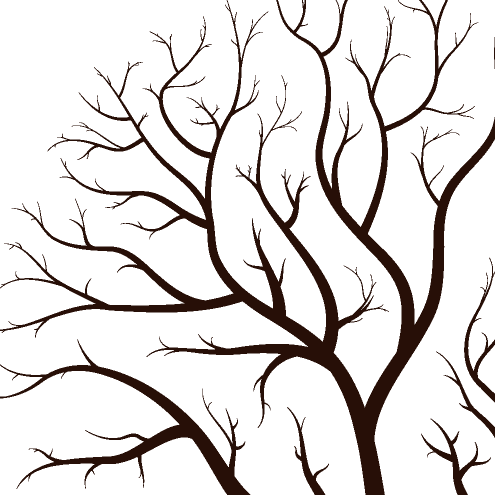
Our common ancestor had a green house at address 17854853 of his/her road. This ancestor had two kids, one of which is my ancestor and the other is your ancestor. A mistake was made when your ancestor was created and his house turned from green to blue. And just so that you do not get offended, mistakes are not necessarily bad. They can be good (advantageous mutation), bad (disadvantageous mutations) or they can make no difference whatsoever (neutral mutations). We now know that most often mistakes make no difference.
So the reason why my house is green and yours is blue is explained by who were our ancestors! Differences are explained by our history but this also means that looking at these differences we can understand our history. Find out what is our story. And this is one of the two reasons why SNPs are important: they allow us to understand where we come from and why we are the way we are!!!
Let me give you an example. I choose lactase persistence since it is a very clear and very famous example and because one of the people I worked with during my PhD worked on this.
Lactase is the enzyme that digests the lactose in milk. In some humans lactase activity decreases after weaning (we call these lactose intolerant). In others, lactase activity persists at a high level throughout adult life (we call these lactorse tolerant). Biologists wanted to find out how did this difference arise, what makes these individuals different. For this reason they had to find the SNPs associated with lactase persistence.
Two SNPs have been identified as the best able to explain why one individual is able to digest lactose and another one isn't. The first is "rs4988235 (−13910C→T)".
Don't be scared! All this means is that:
- the name of the SNP/house is rs4988235,
- the SNP/house is found 13910 houses before the start of the LCT gene, the gene makes the lactase enzyme (for the record the house's actual address is 136325115),
- the house can be either of type blue (C) or red (T), and
- the ancestral house was of type blue (C) so when one has that type of house is lactose intolerant, whereas if their house is red (T) they are lactose tolerant.
The other SNP is "rs182549 (−22018G→A)". You can now guess what this SNP is from my explanation above.
What Bersaglieri et al (2004) did was to look at those two SNP addresses in a number of individuals and count how many of them had one type of house or the other. In other words they wanted to determine the frequencies of the persistence-associated alleles (T in SNP rs4988235 and A in SNP rs182549). The individuals they used came from three populations (European Americans, African Americans, and East Asians) and for each of these individuals they knew if they were lactose tolerant or intolerant. What they found was a correlation between how common were the persistence-associated alleles and the level of lactose persistence in a population. European Americans, the population with the most lactose tolerant individuals, had the greatest percentage of persistence-associated alleles in these SNPs(77%). In contrast, the other two populations show low lactose tolerance and they have the lowest frequencies of persistence-associated alleles in these SNPs (13-14% in African Americans and 0% in East Asians).
So what did we understand about human history from looking at these SNPs? Based on this data, Bersaglieri et al (2004) estimated that these mistakes (C to T in SNP rs4988235 and G to A for SNP rs182549) rapidly became more common at a time near the estimated origin of dairy farming in northern Europe i.e. ∼9,000 years ago. They thus concluded that added nutrition from dairy appears to have provided an advantage in northern Europe. When dairy farming appeared, humans could not drink the milk. Mistakes happened in the DNA of some of these people and since being able to digest lactose gave an advantage, these mistakes spread through the population (i.e. the frequency of the persistence-associated alleles increased). In fact, these mistakes are in the top 3 of the most advantageous mistakes estimated to date.
------
Now lets talk about the P.
Our DNA does not only tell us about our past, but also about our present and our future. In other words, it tells us what we are and what does this mean in terms of our future. We get this information, in other words we understand what makes us the Person we are, when we compare our DNA to that of others. And one of the main reasons we want to do these comparisons is for our health. To predict what will happen to out state of health in the future. I will use cancer as an example.
Almost a decade after the sequencing of the human genome, new technologies have been developed that - given this sequence - make the creation of individual "SNP maps" or "SNP profiles" easier and easier. They also - and maybe more important - make it a lot cheaper.
But what are SNP maps? (I will use SNP maps from now on but SNP maps and SNP profiles are the same thing).
As I mentioned before, most of our DNA does not differ from person to person. Thus, in order to understand what causes our phenotypic differences - e.g. why do I get breast cancer and you are not - we do not need to compare the whole of our genomes. We only need to look at those addresses where there are known differences in the types of house found there. In other words we just need to look at the parts of our DNA which are polymorphic. Our SNPs that is.
A SNP map is like a registry that says what type of house (allele) we have in those addresses (houses) which are known to differ between individuals. It looks a bit like this: individual X at SNP rs4278313 (whose address is 105123) has allele C, at SNP rs9708285 (whose address is 105195) has allele T, at SNP rs9751025 (whose address is 105213) has allele A, etc etc.
But this is not the only source of information that doctors have for each cancer patient: they also know about their phenotype i.e. what cancer they have, for how long, what treatment worked for them and what did not, their sex, their age, their lifestyle choices, etc. etc.
You may now ask me "since doctors have all this other information, why are SNP maps helpful?".
The reason why SNP maps are important is that they can lead to faster and personalised medicine since they can be used
(a) for the better understanding of the cancer (red part of the following figure) but also
(b) for diagnosis and personalised treatment (blue part of the following figure) .
I would say that currently we are mainly using them for the former, but i will explain both of these below.

(taken from http://nci.nih.gov/images/Documents/f6e06278-e717-4465-b5b4-fda72f95584b/cancer41.jpg)
(a) understanding the biology of cancer: when scientists compare SNP maps of individuals with the same cancer, they can find in which SNPs these patients have the same allele and therefore which are the candidates for the cancer-causing mistakes (mutations). In other words, if individual A and individual B both have prostate cancer and they also have allele T at SNP rs4430796, allele G at SNP rs7501939 and allele C rs3760511 C, when men without prostate cancer have C, A and A respectively, then scientists assume that these SNPs are likely to be associated with this cancer. Of course these comparisons happen with a large number of individuals from many populations.
Similarly, SNP profiles can be compared to better understand the response to cancer treatments. If individual A and individual B both have prostate cancer, both got a lot better when prescribed a specific drug and both have the same alleles at a number of their SNPs, then scientists assume that these SNPs a likely to be associated not only with this cancer but also with this treatment.
(b) diagnosis and treatment planning: the stage above is aiming at personalised medicine. In the previous scenario it means that once the SNPs most associated with this cancer have been identified, a test is created to test each man for this set of SNPs. If they are found to have the cancer-causing alleles in these addresses then they have to check their prostate a lot more often than others who do not. In this way the cancer can be diagnosed in the earliest stage, increasing the chances of those people of living a long life. By the way, the first such test exists. A company called Proactive Genomics created two years ago the
What stage (a) is aiming at is the following scenario: patient enters the room, doctor compares the patient's SNP map to the SNP maps of cancer patients. From this comparison the doctor is able to identify immediately, not only the specific nature of the cancer of the patient but also the best treatment for this particular patient. Cancer is diagnosed and treated at a very early stage and patient has less chances of dying because of the cancer.
However, we should not forget the ethics of this "mapping" and also to take into account the patient's psychology. Patients react differently to news about their health. They make a number of decisions some of which could prolong their lives, but others may have the opposite effect. The question you need to ask yourself is: Would you like to know that there is a probability that you will get cancer? Would you have liked to know this at the age of 18? Or 15? or 5? Would you like other people to know about this? Will it be possible for you to restrict who knows and who doesn't? How is this knowledge going to affect your life?
-----
So from now on, when you see or hear something about SNPs remember your S and your P: remember that the importance of SNPs is that they can tell us things about our hiStory and they can lead to Personalised medicine.
Tuesday, 18 May 2010
THE SCIENCE VOTE (#SCIVOTE) MOVEMENT: ORIGINS
Over the last 3 weeks I have been following very closely what was happening before, during and after the recent UK elections but from a scientist's point of view. I copy-pasted every article I could find into Word documents. In the end, these Word documents were more than 300 pages long. I also read all of them and I have been following the twitter discussions as well.
Finally, I wrote the following article for a major Greek newspaper (for those of you who understand Greek and this will not all "sound Greek to you" the weblink for the Το κίνημα "Ψήφος στην επιστήμη" paper is http://www.vimaideon.gr). This is my attempt to translate it. I am saying attempt because the language centre of my brain does not understand anymore which are Greek expressions and which English.
I would really appreciate it if any of the people that were actually part of this movement could tell me which points I've understood wrongly: a third-party always sees things differently and a lot of times not correctly. I can think of many points that might be wrong or annoy people.
THE SCIENCE VOTE MOVEMENT: ORIGINS
The Lisbon Treaty and then European Strategy for 2020 stressed, ambitiously perhaps, the importance of long term investment in knowledge - produced through science and technology - as the only way of exiting from the financial crisis. Politicians in every corner of Europe (and beyond) indicate that the goal of modern society should be a knowledge-based economy.
Nevertheless - whereas the U.S.A., China and India increased their funding for science - Great Britain and other European countries in their general panic to reduce public deficit and debt, announced cuts in public investment in science and technology. In other words, although governments recognize the importance of these investments, they do not apply them. In this way they are risking the future of their country, since a reduction in funding today will lead to future lack of scientific expertise needed to boost economic growth. [businesses seem to agree already on this]
Many British people noticed this paradox during the recent election campaign and their disagreement resulted in the "Science Vote" movement or «#scivote» if one is to use twitter terminology. But what is this movement? What were its aims? Did it succeed in British elections? What is its significance for Greece?
WHEN VOTES MET SCIENCE
Two months before the British elections of May 6th, most people would have bet on a victory of the Conservatives, a party that had made it clear in their manifesto and before the elections that they would promote the greatest and more immediate reductions in the budget for Science and Technology. Faced with this frightening scenario, natural and social scientists, science journalists, skeptics and bloggers united to bring for the first time in the center of discussions fundamental issues concerning science, such as funding, free speech, the importance of evidence-based policy, etc. This had never happened in any country.
The first members of the «#scivote» movement, also could be called "science activists", decided to turn any votes to "science votes" i.e. to inform the British public on the scientific policies of each party, in order to enable them to judge and vote for the party with the best science policy.
The first to react was the non-profit organization "Campaign for Science and Technology" (CaSE), who on the 8th of March 2010, with the support of many major British scientists sent a letter in the Times to the political parties asking them to submit a detailed "scientific" manifesto.
One day later, on March the 9th, the Royal Society of Chemistry organized the first "scientific debate" and first public debate in the House of Commons streamed live over the Internet. In this debate took part representatives from the three major parties. The Liberal Democratic Party was represented by Dr Evan Harris, a leading supporter of and perhaps on the most active politicians in science and technology issues for over a decade. For example, he was a supporter of the reform of libel law in the UK, which made a lot of scientists afraid of speaking in public about their research and their views, in case they were sued by large organisations whose interests were affected [as it happened with Simon Singh]. Of course, not everyone reacted positively to Dr. Evan Harris's actions: extremists named him "Dr. Death", because of his views on abortion, euthanasia, stem cells and animal experiments.
These two events provided an initial impetus to the «#scivote» movement and, thanks to Twitter among other reasons, the movement quickly grew larger. Of particular help was that the Minister for Science, Lord Drayson, like many members of the House of Commons Select Committee on Science and Technology, had a strong and constant presence on twitter. Therefore, through the use of new web tools, there has been over the past few months continuous and direct dialogue on issues of science policy because the views of the movement reached directly the ears of politicians.
The voice of science activists was so strong that it even reached the media. Despite the heat of the election season, there was an increased focus on science in the press: in the last weeks before the election, Mark Henderson in the Times Eureka blog and Martin Robbins in the Guardian, wrote almost daily on scientific policy. The latter - together with five of the most famous British scientists - asked all political parties the same ten questions, so that British people are able to easily compare the science policies of the parties.
After an election season with so many "firsts", those who had bet on a clear victory of the conservatives were regretting it. Nick Clegg, the LibDem leader, had unexpected success in the television debates and in the polls the percentage of his party was increasing. This positive atmosphere gave hope to many members of the «#scivote» movement, since the LibDems were the party that understood the contribution of science and technology in the recovery from the crisis the best. Hence, the slogan «geek the vote, vote LibDems» was created.
THE DAY OF CRISIS
May 6th, 2010. Conservatives get 36.1% of the vote, Labour 29% and the LibDems 23%. As many feared there was a hung parliament, a result of "European style" as some people put it, which shocked Britain. Shocked was the «#scivote» movement as well. "Did we lose?" they whispered. "Were the polls so wrong? Did nobody read the articles we wrote in the press and online?". Anyone would be thinking the same since at first glance the results actually looked like a "disaster":
- The number of MPs who were in some way related to science and technology declined from 86 to 71 and only one of the old "science activists" would be present in the parliament. Of the remaining, some retired and others did not get elected. In the second category is Dr Evan Harris, one of the "leaders" of the movement, who lost for 176 votes.
- Secondly, the Liberal Democrats, the party that expresses best the beliefs of the «#scivote» movement, not only did not win seats as was expected from the very positive election exit polls, but lost five seats (out of the 62 that they had, they got only 57 seats in the recent elections).
Looking closer however, it revealed that the results are not as disastrous as they seem. It might be true that some of the previous MPs positive towards science did not get elected, but many of the newcomers also have a background related to science. The absence of Dr Evan Harris, remains really tragic however. Nor the LibDem performance was that disappointing: the share of votes did not fall as would be expected given the decrease in the number of seats, but increased from 22.1% in 2005 to 23% in 2010. The problem was the "First-Past-The-Post" electoral system, which is considered by many (among them the LibDems) as a system that does not represent what the public wants.
THE PUBLIC SPOKE BUT WHAT DID IT SAY?
For nearly five days after the election, Nick Clegg has negotiated with the two major parties so that they can agree on a coalition. Finally, on Tuesday, May the 11th it was announced that there would be a coalition between the LibDems and the Conservatives.
The fact that the LibDems would be part of the government and therefore had some influence in the administration of the country, did not relieve science activists. Clegg would be able to negotiate only a few points in the coalition agreement between two parties. It would therefore be unlikely that one of them was science. Furthermore, the scientific policy of the Conservatives differ considerably from that of the LibDems, so it was even more unlikely to find a compromise so quickly. For example, the Conservatives support the creation of nuclear power plants, while the Liberals are completely opposed to it.
All would be judged by the agreement between two parties, announced in the afternoon of Wednesday, May 12th, followed by the first public speech of the two leaders of the coalition. This agreement did not clarify at all the situation since it did not contain even once the word science. Instead, it resulted in new questions. "Why did they not mention science? Did they not discuss the issue or did they disagree on many points?" wondered members of the "#scivote" movement.
Their hopes were not lost though. Key would be who would be chosen for the positions of Secretary of State for Enterprise, Innovation and Skills (BIS) and Science and Universities Minister.
After almost a week of suspense for the «#scivote» movement, finally came some good news. First it was announced that Secretary of State for Enterprise, Innovation and Skills would be a LibDem, Dr Vince Cable, who has a degree in Natural Sciences from Cambridge University and a Ph.D. in Economics. Shortly afterwards it was announced that the Conservative David Willetts was appointed Minister of Science and Universities, also known as "two brains" because of his residing hairline, but also because of his cleverness. Willetts studied Politics, Philosophy and Economics at Oxford University. This option was particularly welcome because Willetts had argued in 2007 that science had important role in all sectors of society and that it was essential for all members of the cabinet to appreciate the importance of science and technology in making policy decisions.
AND NOW WHAT?
The team Cable-Willetts was that best that science activists could hope given the current allocation of seats in the British Parliament. It is a great advantage that both ministers are members of the cabinet, and thus they will be able to express their views on science and other issues. An even greater advantage, however, is that the LibDem Dr Vince Cable will oversee Willetts, a smart Conservative, who is pro-science, who also had the respect of Chancellor George Osborne, the one who will approve all ministerial decisions in the new government. Therefore, the future of British science will be influenced by a team with good awareness of the state of science policy before they even begin, and who has the tools and the conditions to bring good science policy about.
Of course not everything is perfect. Many would prefer an practicing scientist in the position of Minister of Science. Also, the movement did not agree with everything Cable and Willetts have said in the past. An important role will also play who will be the members of the House of Commons Select Committee on Science and Technology. There are many battles to be fought in the parliament and outside in order to even keep the British science at its current high level.
The elections were only the beginning. The first battle in which no one can say with certainty whether the "science vote" movement lost or won. On the one hand, the elections reminded members of the movement that they remain a minority. That said, we they should be proud because, as the former Minister of Science Lord Drayson said "#scivote now has a real voice & influence in politics so keep it up! And support the next science minister whoever she/he is".
Now the "#scivote" movement should begin the important and urgent task of educating new MPs on scientific matters. Of convincing party members that science is more than one source of information and knowledge. That it is an important driver of the economy that will play a crucial attention to major issues such as energy independence, and that there should be strong support, even in times of economic cutbacks.
Also, the movement should push for a system that will not be based solely on public funding, but also a "charity-capitalist" organizations, such as The Wellcome Trust, which by their nature are long-term strategy and ambitious and risky objectives which governments by their very nature could never be set.
Furthermore, activists of science should not just preach to the believers. They should turn to those who have not had an interest so far for scientific policy, because only in this way there will changes in the way politics is practiced. Finally, they must convince the new Minister of Science and Universities to use twitter, in order to continue the constructive dialogue they had with the previous minister.
If the "science vote" movement does not act in continuity and consistency, it is certain that science will be one of the areas most affected by the crisis, and thus there will be uncertainty for the future.
But the important thing is that thanks to the science activists, for the first time in history science and technology became an election campaign issue. We must therefore ask ourselves what were the circumstances and why did this movement leave today the area of consensus and entered politics.
Could such a phenomenon have been created in other countries, such as Greece?
NOTE: some of the ideas/thoughts of this article were taken by the various articles I read. I will be linking to these articles in the next few days.
Friday, 7 May 2010
UK Election and #SciVote (1)
Just because I am a geek, I decided to do a little exercise of my own even before the we even know what the government in the UK will be.
First of all for "after-election" articles related to science vote from people that actually know about this topic please click here , here and here.
What I did is that I took the list of MPs published in the Eureka Zone Times paper by Mark Henderson last week.
Given this list, I added next to each constituency the candidate that won. For those where there was information on science background in THAT list I kept this information.
You can find both the original list and the "after election" list here.
So there are 2 massive problems with this dataset:
1) not all 650 constituents are on there and
2) when we say that an MP has a science background as Mark Henderson mentioned
What I am saying is, I am aware that the following plots are not very well evidence-based and that they could lead to misinterpretation. If you are ok with this please read on, otherwise please leave this post (hopefully not the whole blog :P).
OK so here we go....

Out of 155 constituancies (I found a double in the list from the Times article), 70 had a "science background" and the last one for which right now we do not have the results is likely to be the 71st that is mentioned in the new article by Mark Henderson.


And then I looked at each party separately:
 The results are not unexpected given all those articles I have been reading the last two weeks on which I will report soon (hopefully). LIBDEMs is the party who has more MPs with science background" than with "non-science or unknown background". Labour has more or less equal proportions whereas the Conservatives (and other parties) have a higher proportion of MPs with non-science or unknown backgrounds.
First of all for "after-election" articles related to science vote from people that actually know about this topic please click here , here and here.
What I did is that I took the list of MPs published in the Eureka Zone Times paper by Mark Henderson last week.
Given this list, I added next to each constituency the candidate that won. For those where there was information on science background in THAT list I kept this information.
You can find both the original list and the "after election" list here.
So there are 2 massive problems with this dataset:
1) not all 650 constituents are on there and
2) when we say that an MP has a science background as Mark Henderson mentioned
- "we don't mean to suggest that you need to have a background in science to become an effective Commons advocate for it" and
- a background in science does not necessarily mean that an MP will be actively engaged in it, or promote it in Parliament.
What I am saying is, I am aware that the following plots are not very well evidence-based and that they could lead to misinterpretation. If you are ok with this please read on, otherwise please leave this post (hopefully not the whole blog :P).
OK so here we go....

Out of 155 constituancies (I found a double in the list from the Times article), 70 had a "science background" and the last one for which right now we do not have the results is likely to be the 71st that is mentioned in the new article by Mark Henderson.

Out of the 70 MPs with "science background" 36 have degrees in the "hard sciences" i.e. physics, maths, chemistry, biology etc, 19 had degrees in engineering, 9 are medical doctors or dentists and for the rest it is not specified even though they are stated as having a "science background". Most of these belong to the Science and Technology Committees or held science related roles in the past (correct me if I am wrong since once again I did not have the time to check this: Graham Stringer, Malcolm Wicks, Adam Afriyie, Roberta Blackman-Woods, Rob Flello).

So then I wanted to see what is the distribution of MPs in the different parties once they have been sorted according to background:

And then I looked at each party separately:
 The results are not unexpected given all those articles I have been reading the last two weeks on which I will report soon (hopefully). LIBDEMs is the party who has more MPs with science background" than with "non-science or unknown background". Labour has more or less equal proportions whereas the Conservatives (and other parties) have a higher proportion of MPs with non-science or unknown backgrounds.
So this is my little research. Of course any comments are MORE THAN WELCOME!!!
I repeat that the information I had was only for 155 constituencies out of 650 and that having a "science background" does not make you necessarily more likely to "defend science". I am not claiming that this is a complete research.
But the results are interesting nevertheless! :)
Friday, 30 April 2010
digital literates vs illiterates: are we going towards the right direction?

But you can also see from this cloud why I have not written anything. The ratio between information and knowledge is massive. That is why I decided to stop. And if I miss things, which I am sure I will, then I can catch up later.
But I did not write this post to whine. Fortunately or unfortunately I am not a whiner. I wrote this post to make a little comment. A naive comment. A comment which might sound a bit weird from someone that believes in the importance of knowledge and the equal and open access to knowledge.
THERE IS TOO MUCH INFORMATION OUT THERE!
Seriously! Have you noticed???
It is not as if I have been "away" for the last 5 years.
I have been online, I have been looking and searching.
The only thing I am doing different now, compared to... say... 3 years ago is that I am looking online for something that is very new to me. And relatively broader than what I used to be searching for. You will agree that it is not very likely that there is more information on chicken microsatellites than... say... Digital Economies.
In a way I feel sorry for the people that are starting now their lives. There is so much more information out there than it used to be. As many times more information I had compared to my parents. Information increases exponentially!!!!
There is too much information out there. I can spend my whole day following the twitter updates of the people I follow and clicking on the links they are referring to, without even reading any of the links.
Is this right??? Are we going towards the right direction???
If I start blaming anyone, I start with myself: I have been writing my little blog for more than a year now, and as if this was not enough, I started this one too. Everyone puts information online. Useful, interesting, useless information all mixed up.
And I ask again, are we going towards the right direction???
There was a conference this week somewhere in the US. It was called Future of Web 2010. The papers that summarize the plenary talks of that conference are on the massive virtual pile that I will be reading. These people are working on the issue I mention here. Most probably if, instead of writing this post, I read those reports I would be getting my answers. These people are working on this exact thing: a whole conference on the future of the web. I hope they have something to suggest, because in my opinion
THIS IS NOT THE WAY FORWARD!!!
Don't get me wrong. I am all pro-information!!! I am pro-knowledge!!! I am saying this, even though such a statement is a bit pointless, since I cannot think how could anyone not be pro-knowledge, but I am mentioning it just to make a point: I am all for open access to information. I am all for it!!! But I am also saying is that i have a feeling that this is not the way forward.
And given that we are living a globalised world and given that i know that most people who are using the internet are not using it like me - for example they follow their friends, musicians and celebrities on twitter instead of people whose bios have to do with:

- given these things I think we are going towards a world where there is going to be a "digital literate elit", i.e. people that know the right things and the right people - and a "digital illiterate class" which will not be able to advance itself because it cannot use the internet to its advantage. And like in all early stages of new societies (i think at least with my limited sociology knowledge), the latter is going to be massive and the former tiny.
I am sure all the social media and web specialists have better terms for these groups of people.
I would also like to mention that I am not sure that the digital illiterates have it wrong. These people are out there socialising in the physical world or the digital world. After all, we are human beings: we want to entertain and amuse ourselves. Not all people are like me that I live on learning and working and if I do not have something to interest me I get depressed.
I repeat I am not sure these people have it wrong. But in terms of their careers and hence in terms of the position of this new society and their ability to put food on their table, they will definitely have a disadvantage.
And I am not talking about digital natives and immigrants because I sometimes feel that I am an immigrant too. Yes I am using most Web2.0 tools, yes I am very good at finding information online - maybe too good by the looks of it - but I am not as digitally native as I thought I was. Imagine what this little girl will be like when she reaches high-school:
I cannot even imagine!
It is not about the access to the information. Is about the fact that these people are not going to be looking for it. Not because they are stupid. Just because they are human. And with the speed that information is increasing, I cannot say that I blame them!!!!
Thank you for reading!
Saturday, 24 April 2010
European Citizen’s Agenda of Science and Innovation
I finally got back to Athens 2 days ago: I was supposed to be away in Paris for 8 days but I ended up staying for 2 weeks due to the volcano eruption. I cannot really complain. :P The only problem is that when you are stranded away from home it is more difficult to write your blog! :)
Anyway the meeting in Paris was related to knowledge, science, youth, communication and policy issues and I learned a lot of interesting things that I will mention in my future posts. For the time being I suggest to the European people that might fall into this blog, to go and vote at the website that is mentioned below.
The following text i copied pasted it from the e-mail I was sent:
Check out the video (has English subtitles):
Vote here: www.reto2030.eu
Anyway the meeting in Paris was related to knowledge, science, youth, communication and policy issues and I learned a lot of interesting things that I will mention in my future posts. For the time being I suggest to the European people that might fall into this blog, to go and vote at the website that is mentioned below.
The following text i copied pasted it from the e-mail I was sent:
Science and innovation have played an essential role in our history. The search for knowledge to advance together is one of the pillars of European culture.
Creativity, innovation and enterprising spirit are essential values we should feel identified with in order to tackle the enormous challenges faced by Europe both today and in 2030.
What is the Citizen’s Agenda of Science and Innovation?
The Fundación Española para la Ciencia y la Tecnología (FECYT) has embarked on an awareness campaign in which European citizens are going to be able to inform top level representatives of science and innovation in Europe about what challenges should be addressed in these two areas in the time horizon until 2030.
Marking the Spanish presidency of the European Union in the first half of 2010, and with the support of the Spanish Ministry of Science and Innovation, FECYT presents this unique and innovative initiative to all the citizens of Europe: the Citizen’s Agenda of Science and Innovation.
You are going to change our lives.
The Citizen´s Agenda includes 14 challenges that will change our lives by 2030. Which do you think should be included in the agendas of our European representatives so it can become a reality?
Discover 14 exciting challenges for the future and choose one. Choose your challenge now!
Check out the video (has English subtitles):
Vote here: www.reto2030.eu
Subscribe to:
Posts (Atom)